EnterprisePricing


Your client just emailed asking for a status update on a project you finished updating in your project management tool an hour ago. They never saw it. They never will, because your tool doesn't let clients in, or if it does, it looks like an internal dashboard with their name stuck on top.
That gap between what you track and what your client sees is where trust quietly leaks out of a service business. A branded, permission-safe client portal closes it.
TL;DR
- Client portals fall into two camps: no-code builders you customize yourself (Softr, Airtable, Stacker, Knack, Noloco) and add-on portals bolted onto a bigger tool (monday.com).
- The differences that matter for a small service firm are custom branding, role-based access control, secure data permissions, and how well the portal handles approval workflows without extra tools.
- The average company now runs 101 different apps, according to Okta's 2025 Businesses at Work report, so a portal that consolidates client communication instead of adding another silo is worth more than one with the flashiest UI.
- Weak permissions are not a small risk: the global average cost of a data breach reached $4.44 million in 2025, per IBM's Cost of a Data Breach Report, and third-party access is a recurring cause.
- Noloco is included because it takes the "portal on top of your data" approach further, connecting to your existing Airtable base while adding the operating system layer around it.
What makes a client portal "branded" instead of just functional?
A lot of tools technically let clients log in and see something. Fewer let that something look like your software instead of a generic dashboard with your logo pasted in the corner.
Custom branding for a client portal usually means: your own domain, your fonts and colors applied to the whole interface (not just a header banner), no "powered by" watermark on lower tiers, and layouts that can be redesigned without starting from a rigid template. This matters more for professional services than it sounds. Clients form an opinion about how organized your firm is the moment they log in, before they read a single project update.
Which client portal tools actually support role-based access control?
Every tool on this list claims permissions. The difference is depth. Page-level permissions decide who can open a screen. Field-level and record-level permissions decide what that person sees once they're on it, which matters when internal staff and external clients are looking at the same underlying data.
Softr and Stacker apply permissions mostly at the page and view level. Knack and Airtable get closer to record-level control but require more manual setup as the number of client roles grows. monday.com's client-facing features sit on top of a tool built for internal team permissions first, so external access is often an add-on rather than a core design choice. Noloco applies permissions directly at the data level, so one rule holds whether the view is a table, a dashboard, or a form, and it holds automatically as new clients and records get added.
See why agencies choose Noloco to run internal operations and client collaboration together in one secure, branded portal:
How do these platforms compare on branding, permissions and automation?
What should a small service business look for before choosing a client portal?
Price per seat is the first thing most founders check, and it's the wrong first question. The right one is: what happens to this decision when you go from 10 clients to 50? A portal that charges per external login gets expensive fast. A portal with shallow permissions gets risky fast. Use the checklist table below to sort priorities before you compare pricing pages.
How does Noloco compare for service firms that want more than a portal?
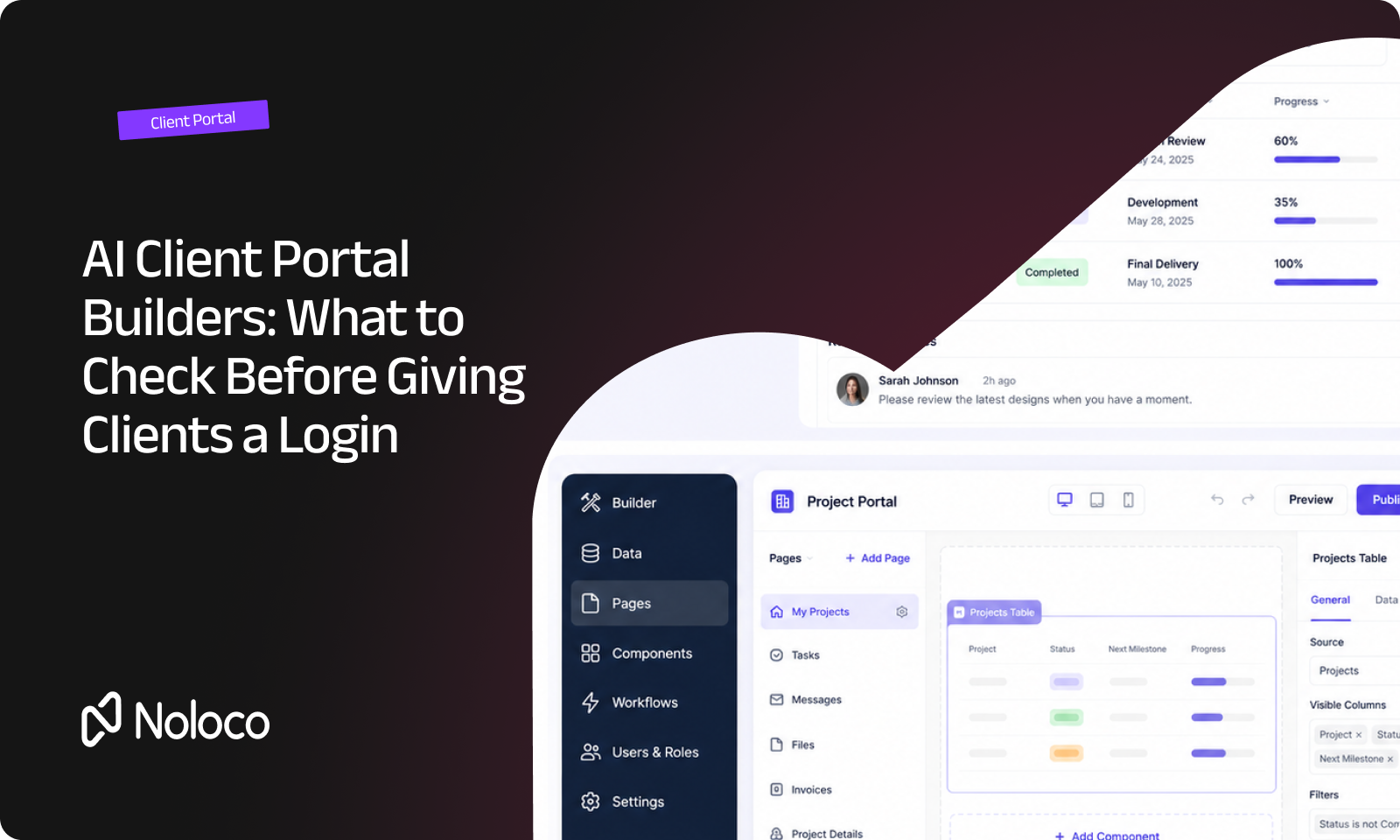
Most tools on this list solve one problem: giving a client a screen to look at. Noloco starts from the same need but treats the portal as one piece of a bigger system: the same data powers your team's internal workspace, your CRM, and your client-facing views, all governed by one set of permission rules.
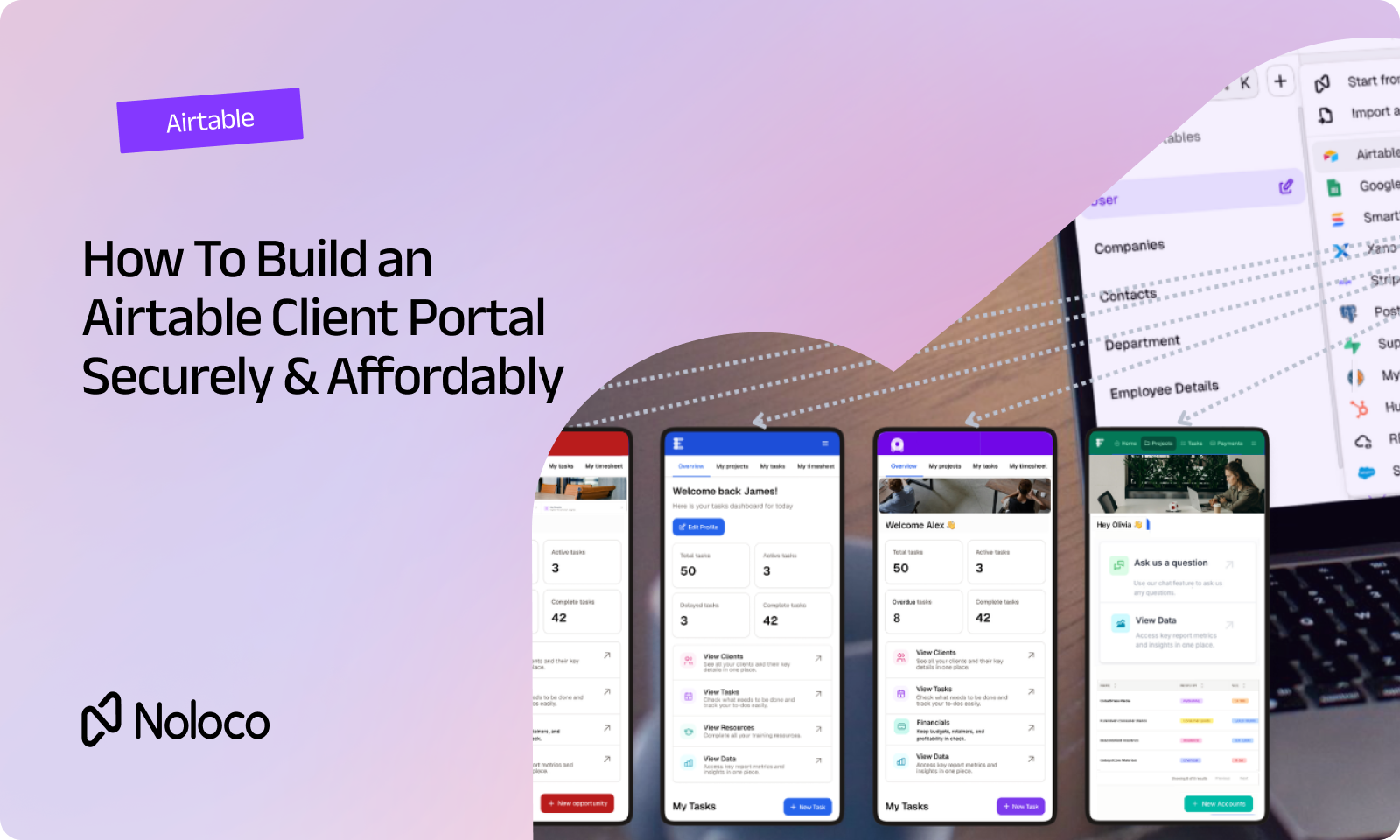
If you're already running your business on Airtable, this doesn't mean ripping it out. Noloco connects natively, so your Airtable base stays the data layer while Noloco adds the interface, granular permissions, and branded portal on top. Redrock Entertainment used exactly this approach, layering Noloco onto their existing Airtable base for over 100 users and cutting their software costs by 60% in the process, according to Jesse VanDenGooy, their Technology Solutions Architect.
Final thoughts
A client portal is the one piece of software your clients actually see. Everything else, your CRM, your internal project boards, your spreadsheets, stays invisible to them. That makes branding and permissions less of a nice-to-have and more of a direct signal of how well-run your firm is.
Start with the checklist, not the feature list. A portal that scales cleanly as you add clients, and that doesn't require you to rebuild permissions by hand every time someone new joins, will save more time in year two than any individual feature will in month one.
FAQ
What is a client portal for a service business?
A client portal is a secure, branded space where clients log in to see project status, approve work, request changes, and access documents, without needing access to your internal tools.
Do client portals need to be a separate piece of software?
No. Many firms add a portal layer on top of their existing data source, such as Airtable, rather than adopting an entirely separate system.
What is the difference between role-based and field-level permissions?
Role-based permissions control which pages or sections a user can open. Field-level permissions go further, controlling exactly which pieces of data on a shared page each user can see, which matters when staff and clients view the same records.
Is Airtable a good client portal on its own?
Airtable is a strong data layer, but its native sharing options are limited for client-facing work. Most firms pair it with a front-end tool for a real portal experience.
How much does client portal software typically cost?
Pricing varies widely by model. Some tools charge per user, which gets expensive as client count grows; others use record-based or bundled pricing that scales more predictably.
Can a client portal replace project management software entirely?
For firms that want one system instead of several, a portal built on a flexible operating system can absorb project tracking, client communication, and internal workflows in one place. Firms that want to keep tools separate can also just add a portal layer on top of what they already use.
Related resources
- Consultancy management software: what to look for
- CRM vs project management: what's the real difference
- Why agencies replace spreadsheets with no-code systems
- Professional services operating system, explained
- Client Portal solution page
- Agency Operating System solution page
Author



Our recent posts
Explore all blog posts
Your most common
questions—answered!
Who is Noloco best suited to?
+
-
Noloco is perfect for small to medium-sized service businesses like consultancies, agencies, advisory firms, as well as engineering and industrial services such as energy, construction, or any other operations-focused fields.
Do I need tech experience to use the platform?
+
-
Not at all! Noloco is designed especially for non-tech teams. Simply build your custom system using a drag-and-drop interface. No developers needed!
Is my data secure?
+
-
Absolutely! Security is very important to us. Our access control features let you limit who can see certain data, so only the right people can access sensitive information
Do you offer customer support?
+
-
Yes! We provide customer support through various channels—like chat, email, and help articles—to assist you in any way we can.
My business is growing fast—can Noloco keep up?
+
-
Definitely! Noloco makes it easy to tweak your system as your business grows, adapting to your changing workflows and needs.
Is there any training or support available to help my team get up to speed?
+
-
Yes! We offer tutorials, guides, and AI assistance to help you and your team learn how to use Noloco quickly.
Can I make changes to my app after it’s been created?
+
-
Of course! You can adjust your app whenever needed. Add new features, redesign the layout, or make any other changes you need—you’re in full control.

Ready to boost
your business?
Build your custom tool with Noloco