EnterprisePricing

A property manager approves a maintenance invoice by email, a broker sends a listing agreement through a shared Google Drive folder, and a tenant asks for a lease update over text. None of it lives in one place. By the time a deal closes, the paper trail is scattered across four different tools and nobody, including the client, is fully sure what's still outstanding.
That's the exact problem client portal software is meant to solve, and it's why more real estate teams are shopping for one in 2026.
TL;DR
- Client portals give real estate teams one branded, secure place for clients, owners, and tenants to view status, approve work, and share documents, replacing email threads and shared drives.
- The market has shifted firmly toward cloud-based tools: 68% of users now prefer cloud-based portals with built-in collaboration, e-signature, and role-based access, according to a 2025 Global Growth Insights report on the client portal software market.
- Softr, Airtable, monday.com, Knack, and Stacker all offer some version of a client-facing view, but they differ sharply on permission depth, approval workflows, and how they price client access.
- Real estate teams have specific needs a generic portal often misses: multiple stakeholder types (owners, tenants, buyers, vendors), documents that need approval trails, and branding that has to feel like the agency's own product.
- Noloco is built for exactly this: granular permissions, built-in approval workflows, and full branding, without charging per client seat.
What makes a client portal actually work for real estate teams?
Real estate is a stakeholder-heavy business. A single deal or property can involve an owner, a buyer, a tenant, a property manager, a vendor, and an agent, and each of them needs to see something different.
A client portal that works for this environment needs three things: a place for each stakeholder type to log in and see only their own information, a way to request and approve things (a repair, a lease renewal, a disclosure) without it turning into an email chain, and a look and feel that matches the agency's brand rather than the software vendor's.
Most generic portal tools nail one of these. Few nail all three.
Why do real estate teams need better approval and permission workflows now?
Real estate has been quicker than most service industries to adopt digital tools for signatures and documentation, but slower to consolidate them into a single system.
eSignature is now the most widely used piece of technology among real estate professionals, used by 79% of Realtors, ahead of social media and drone photography, according to the National Association of Realtors' 2025 Technology Survey. Clients have noticed and responded well: 82% of agents say clients react positively when technology gets folded into the buying and selling process, per the same survey.
The catch is that eSignature alone doesn't solve the visibility problem. A signed document that then gets emailed to three people and saved in two different drives is still fragmented. And fragmentation carries real risk, not just inconvenience: the global average cost of a data breach reached $4.44 million in 2025, according to IBM's Cost of a Data Breach Report, with weak access controls and scattered data among the most common contributing factors.
For a real estate team handling financial documents, IDs, and signed contracts across multiple stakeholders, a portal with real permission structure isn't a nice-to-have. It's the thing standing between "our clients trust us with their information" and a very uncomfortable phone call.
How do the top client portal tools compare for real estate teams?
Here's how the main options stack up on the things that matter most for real estate: approval workflows, permission depth, branding, and how each one handles client access as your roster grows.
A few things worth calling out from that table:
Softr and Airtable are strong starting points, especially if your data already lives in Airtable. Airtable's own Interfaces are genuinely good for simple internal views, but permission depth for external, client-facing use tends to hit a ceiling once you have more than a couple of client types to manage. Softr's a similarly quick way to put a front end on existing data, though approval logic usually needs to be built with workarounds rather than being native.
monday.com is built for internal team tracking first. Client access is possible but usually means either giving clients more visibility than you'd like, or paying for extra guest seats as your client list grows.
Knack and Stacker both offer no-code app building with some portal capability. They're worth evaluating directly against your specific approval and permission needs, since coverage varies by plan and use case.
Which client portal fits which type of real estate team?
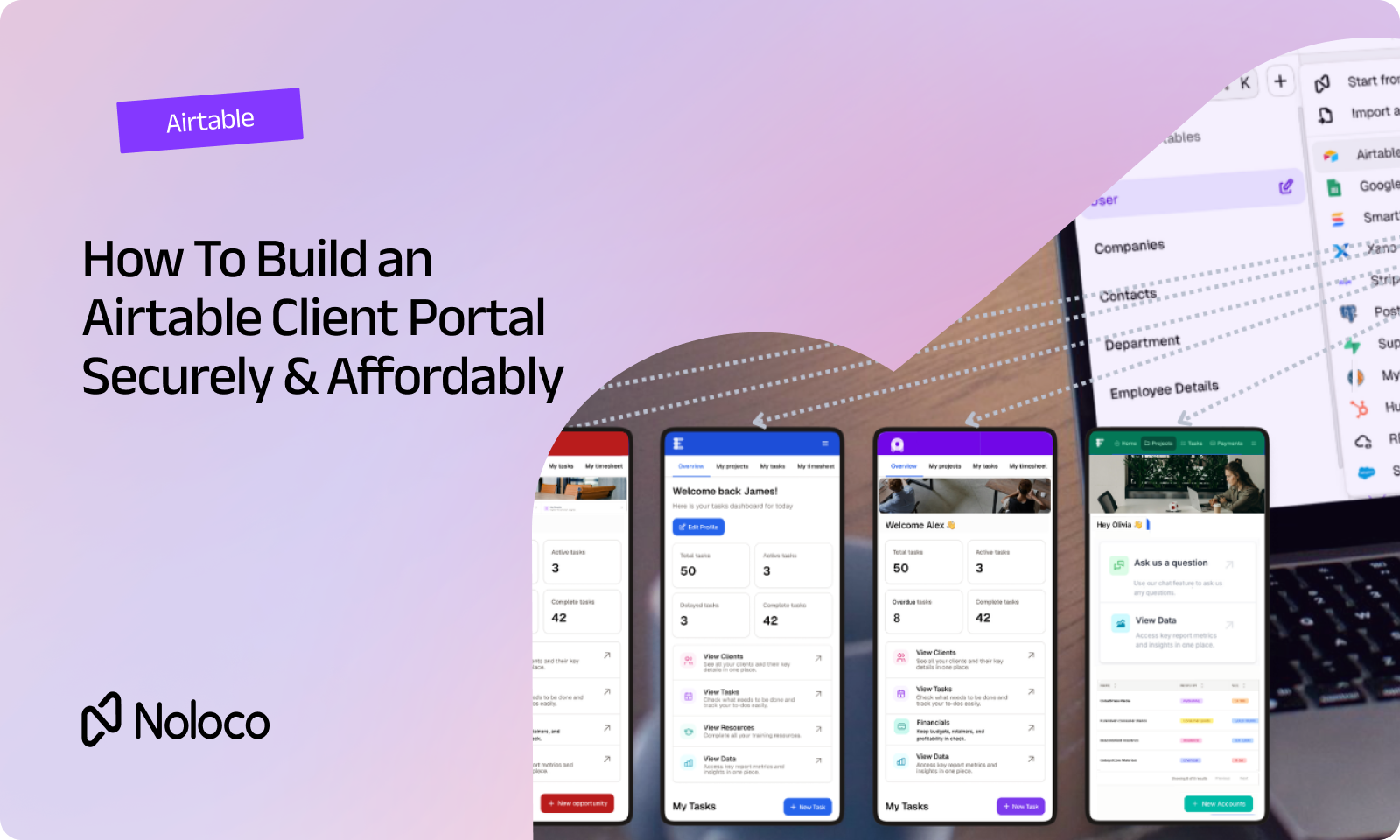
If your team is already running on Airtable and doesn't want to migrate, you don't have to. Noloco connects directly to an existing Airtable base and adds the client-facing layer, permissions, and approval workflows on top, so the switch is a front-end change, not a data migration. Redrock Entertainment took this exact approach, using Noloco as the interface layer over Airtable for more than 100 users, and cut their software costs by 60% in the process. As Jesse VanDenGooy, Technology Solutions Architect at Redrock Entertainment, put it, moving off per-seat pricing while keeping their Airtable data in place was the change that made the math work.
What should a real estate team check before choosing a client portal?
A few questions to run through before signing up for anything:
Can each stakeholder type see only their own data? An owner shouldn't see another owner's financials, and a tenant shouldn't see the property manager's internal notes. This needs to work at the record level, not just the page level.
Does the tool support real approval workflows? A client approving a repair estimate or a disclosure should trigger the next step automatically, not require someone on your team to notice and process it manually.
Is client access priced per seat? If a tool charges per external user, your costs climb every time you add an owner, tenant, or buyer to the system. For a growing real estate team, that adds up fast.
Can you brand it as your own? Clients working with a real estate team expect a polished, professional experience. A portal with someone else's logo undercuts that.
How does Noloco handle client portals for real estate teams?
Noloco gives real estate teams one system where the team and their clients, owners, and tenants all work from the same data, with each seeing only what's relevant to them.
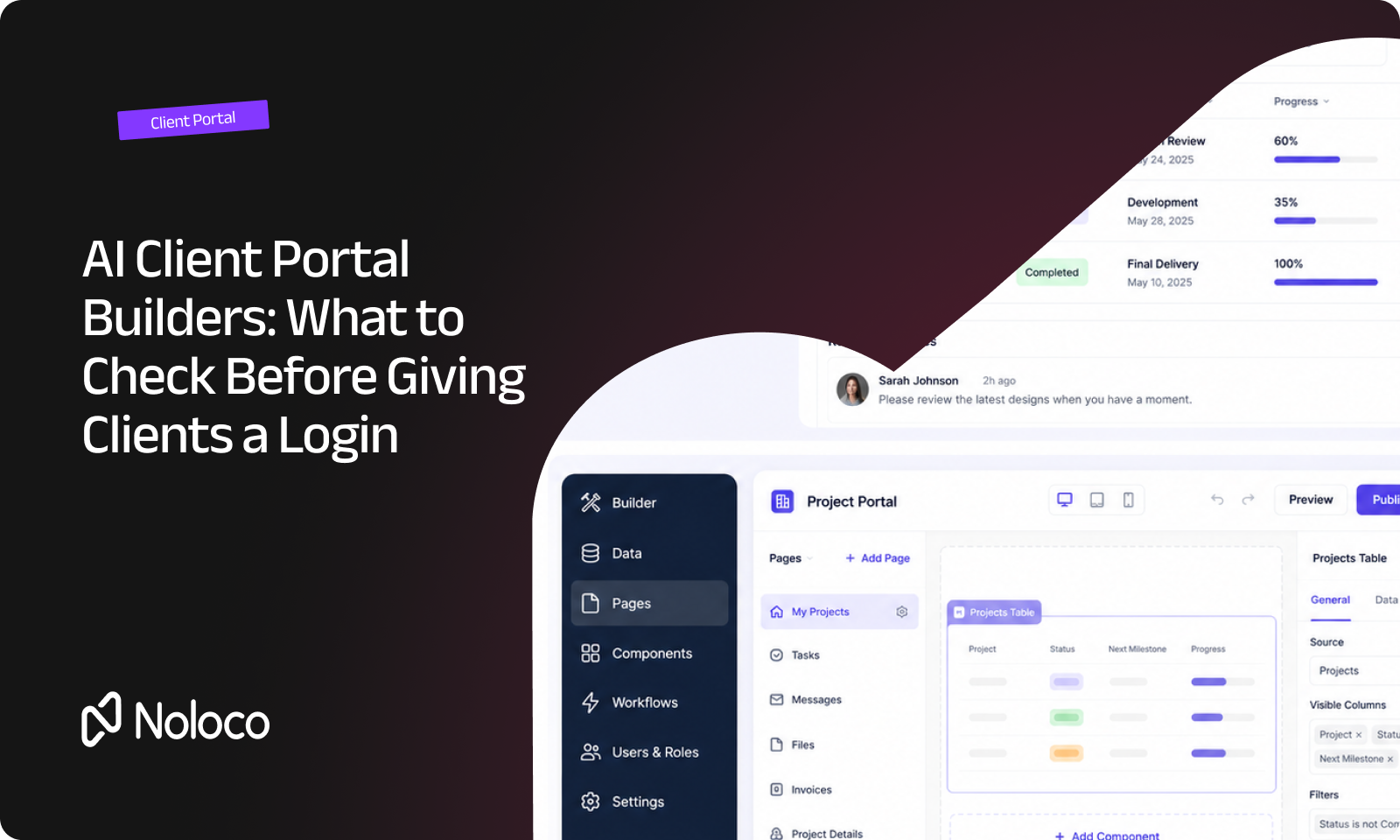
Permissions work at the record and field level, so an owner sees their property's financials while a tenant sees only their lease and maintenance requests, all from the same underlying database. Approval actions (sign-off on a repair, acceptance of a disclosure, confirmation of a lease renewal) trigger workflows automatically, so nothing depends on someone remembering to check an inbox. And because client seats are bundled rather than charged individually, adding a new owner or tenant to the portal doesn't move the needle on your bill.
The whole thing runs on your existing data, whether that's Airtable, Google Sheets, or a database you set up from scratch in Noloco, so there's no separate system to keep in sync.
Final thoughts
Real estate teams don't need another tool that adds a client-facing veneer to internal data. They need a system built around the reality that owners, tenants, buyers, and vendors all need different, secure views into the same set of records, with approvals that move without a team member chasing them down. Softr, Airtable, monday.com, Knack, and Stacker each solve part of that. Noloco is built to solve all of it, without punishing you for growing your client list.
FAQ
What is client portal software?
Client portal software gives external stakeholders, such as clients, owners, or tenants, a secure, branded space to view information, submit requests, and approve work, without relying on email or shared drives.
How much does client portal software cost for a real estate team?
Pricing varies widely, and the biggest factor to check is whether client access is charged per seat. Tools that bundle client seats tend to scale better for real estate teams adding owners or tenants regularly.
Can a client portal replace email and PDF approvals for a real estate transaction?
Yes, when the portal has real approval workflows built in. The approval action needs to trigger the next internal step automatically; otherwise, the process just moves from email to a different inbox.
Do real estate teams need to build a client portal from scratch?
Not necessarily. Several tools, including Noloco, offer ready-made structures for client, project, and approval data that can be customized rather than built from a blank canvas.
What permissions does a real estate client portal actually need?
At minimum, record-level permissions so each owner, tenant, or buyer sees only their own property and documents, and ideally field-level permissions so sensitive financial details can be hidden from stakeholders who don't need them.
Can a client portal connect to an existing Airtable base?
Yes. Tools like Noloco, Softr, and Stacker can all connect directly to an Airtable base and use it as the underlying data source, so a real estate team doesn't need to migrate data to get a proper client-facing layer.
Related resources
- Why client portals fail service businesses (and what to do about it)
- Secure client portal permissions for service businesses
- Best client portal software for growing service teams
Author



Our recent posts
Explore all blog posts
Your most common
questions—answered!
Who is Noloco best suited to?
+
-
Noloco is perfect for small to medium-sized service businesses like consultancies, agencies, advisory firms, as well as engineering and industrial services such as energy, construction, or any other operations-focused fields.
Do I need tech experience to use the platform?
+
-
Not at all! Noloco is designed especially for non-tech teams. Simply build your custom system using a drag-and-drop interface. No developers needed!
Is my data secure?
+
-
Absolutely! Security is very important to us. Our access control features let you limit who can see certain data, so only the right people can access sensitive information
Do you offer customer support?
+
-
Yes! We provide customer support through various channels—like chat, email, and help articles—to assist you in any way we can.
My business is growing fast—can Noloco keep up?
+
-
Definitely! Noloco makes it easy to tweak your system as your business grows, adapting to your changing workflows and needs.
Is there any training or support available to help my team get up to speed?
+
-
Yes! We offer tutorials, guides, and AI assistance to help you and your team learn how to use Noloco quickly.
Can I make changes to my app after it’s been created?
+
-
Of course! You can adjust your app whenever needed. Add new features, redesign the layout, or make any other changes you need—you’re in full control.

Ready to boost
your business?
Build your custom tool with Noloco