EnterprisePricing

Last updated: August 20, 2026
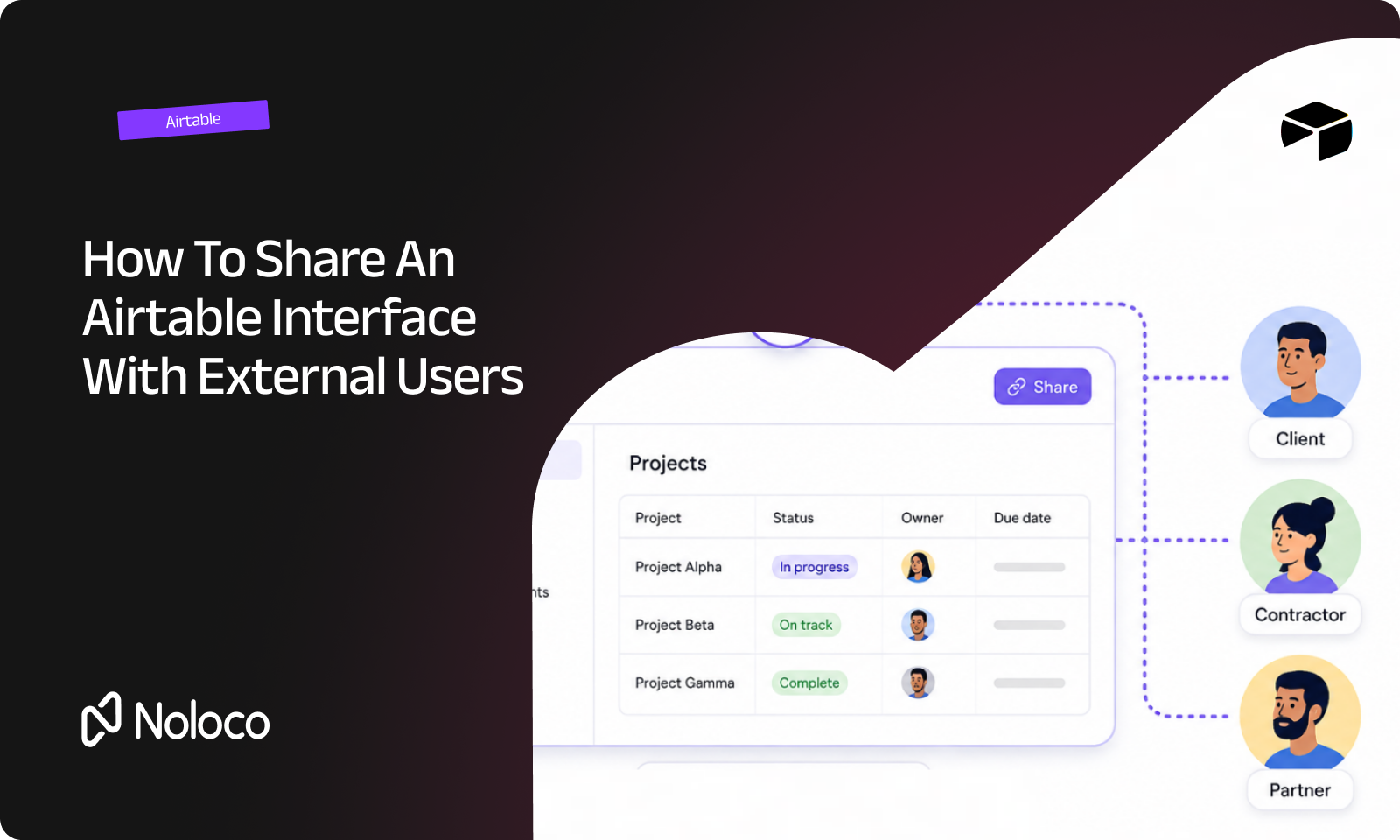
You've built an Airtable interface to track projects, shipments, installations, cases, or client work. Now someone outside your company needs access and they may need to do more than just look at the data. Maybe it's a client who wants to check project progress, a contractor who needs to update a job or a partner who needs to review their own data without seeing everyone else's.
The good news: Airtable gives you several ways to share an interface.
The important part is choosing the right one. A public link, an interface-only collaborator, and Airtable Portals solve different problems. The wrong choice can leave you managing too many guest accounts, paying for external editors, or rebuilding the same experience for every client.
TL;DR
If you want to share an Airtable interface with external users:
- Use a public link when someone only needs to view a single page and doesn't need to log in.
- Invite an interface-only collaborator when you know exactly who needs access and they need to view, comment, or edit.
- Use an invite link when you want to give multiple people access without inviting every person manually.
- Use Airtable Portals when external clients, vendors, or partners need ongoing access to your interfaces.
- If every client needs their own login, their own data, and a branded place to work with your team, you may eventually want a dedicated client portal like Noloco instead.
What are your real options for sharing an Airtable interface with someone outside your company
Before sharing anything, decide what the external user actually needs to do.
The main difference is how controlled the access needs to be. If you're showing a customer one project status page, a public link might be enough. If you're giving ten contractors access to update jobs, you'll need something more controlled. And if every client needs a login to see their own projects, requests, invoices, or documents, you're moving into portal territory.
| If you need more than sharing an Airtable interface: These options work well when your goal is to give someone access to Airtable. But if clients or partners need to log in, submit information, upload documents, track work, or interact with your team, you're solving a bigger problem than interface sharing. That's where a dedicated portal like Noloco can make sense. You can keep your Airtable data and give external users a separate place to work with it.
How to share an Airtable interface with a public link
A public link is the simplest option. You can share an individual interface page with someone who doesn't have an Airtable account.
How to do it
- Open the base containing your interface.
- Go to Interfaces.
- Open the interface you want to share.
- Click Share interface.
- Select Share to web.
- Choose the page you want to share.
- Turn on public sharing.
- Copy the generated link.
You can also manage settings for the link, including requiring a password or disabling the link later.
When should you use a public link?
Use it when the person only needs to look at information. For example:
- A customer checking shipment status
- A client viewing a project summary
- A partner reviewing a dashboard
- A homeowner checking an installation date
The downside
A public link is not a real client login. Everyone with access to the link sees the same shared page. You can't give one person a different permission level from another through the same public link. It is also read-only.
So this option stops working when someone needs to:
- Update a record
- Leave comments
- Submit changes as part of an ongoing workflow
- See information specific to their account
For that, you need authenticated access.
How to invite someone to an Airtable interface
If you know exactly who needs access, you can invite them as an interface collaborator.
This lets you give someone access to an interface without necessarily giving them access to the underlying Airtable base.
How to do it:
- Open the interface.
- Click Share interface.
- Go to the collaborators section.
- Invite the person by email.
- Choose their permission level.
Permission levels - Airtable offers three main interface permission levels:
- Read-only: The person can view the interface but cannot change records. Use this for someone who needs to check information but shouldn't update it. Example: A client checking the status of their project.
- Commenter: The person can view the interface and leave comments. Example: An external reviewer giving feedback on a case or deliverable.
- Editor: The person can update records and interact with editable parts of the interface. Example: A contractor updating the status of a job assigned to them.
When should you use interface-only access? - This works well when you're sharing with a small, known group of people.
For example:
- One auditor
- Five subcontractors
- A partner company's operations team
- A small group of clients who need regular access
It becomes harder to manage when you're repeatedly asking "Which client has access to which interface?" or "How do I give every new customer their own login?" At that point, the sharing problem is becoming a bigger part of your operation.
How to share an Airtable interface using an invite link
You can also create an invite link that grants people access to an interface. This can save you from inviting every person individually.
When you create the link, you can choose:
- The permission level it grants
- Whether it gives access only to specific interface sections or more broadly
- Who can use it
Be careful with the access level: Before sending an invite link, check exactly what the person will be able to access. In particular, don't give someone access to the underlying base when they only need the interface. If you're sharing with people outside your company, keep the principle simple: Give them access to the smallest amount of information they need to do their job.
When should you use an invite link? - Invite links are useful when:
- You're onboarding a group of external users
- You don't want to manually invite every person
- Everyone receiving the link should get the same level of access
They are less useful when every external user needs a different experience. For example, if Client A should see only Client A's projects and Client B should see only Client B's projects, you need to think carefully about how access and data filtering are configured.
Can you share an Airtable interface with external users?
Yes, but there's an important question to answer first: are you just sharing information, or does the external person need to actually take part in the workflow? If they only need to check a project status, a public interface link may be enough. If they need to update a job, upload a document, approve something, submit a request, or see information specific to their company, you're no longer just sharing an interface; you're giving an external person a place to work with your business.
That distinction matters because the more external users do, the more you'll need to think about:
- Who can see which records
- Who can edit or approve information
- How clients, contractors, and internal staff get different access
- What happens when you add your 20th, 50th, or 100th external user
- Whether the experience looks like your business or like an Airtable interface
That's where Airtable's different sharing options start to diverge.
What is Airtable Portals?
Airtable Portals is Airtable's feature for giving external people ongoing access to interfaces. It is designed for use cases such as clients, vendors, contractors or partners. Instead of treating every external person like another internal Airtable user, you can invite them into a portal experience.
Portal users can access interfaces you share with them at their assigned permission level. Airtable also limits what they can do compared with regular internal users. For example, portal users cannot share the interface with other people.
On Business and Enterprise Scale plans, Airtable also lets you customize the portal sign-in experience.
When does Airtable Portals make sense? - Portals make sense when you're moving beyond: "I occasionally need to share an interface." and toward: "Every client needs ongoing access to information and workflows." For example:
- A finance operations team giving clients access to their own cases
- A transport company giving customers access to shipment information
- An education operations team giving partner organizations access to their data
- A solar company giving customers access to installation updates
At this point, you're not really solving a sharing problem anymore: You're building a client-facing part of your operation.
How much does Airtable Portals cost? - Airtable Portals is a paid add-on. At the time of writing:
Additional portal seats are available in larger packs. One important detail: read-only portal users are not counted as billable portal seats. The cost becomes more relevant when external users need higher levels of access, such as commenting or editing.
So before adding Portals, ask: How many people actually need to change data? If you have 100 clients who only need to check project status, the answer may look very different from a workflow where 100 external users need to update records every week.
But cost isn't the only thing to consider. Once clients are actively participating in your workflow, you also need to consider the experience you're giving them and how much of your operation you want to expose through Airtable's interface.
How do you make sure each external user only sees their own data?
This is usually the hardest part. For most teams the goal isn't just to give clients access, but more often to give every client access to their own information without showing them anyone else's.
For example, imagine you manage 50 clients in one Airtable base and each client should see: their projects, their requests, their documents, and their invoices. But Client A must not see Client B's records.
Airtable lets builders use permissions and filtering to create different experiences for different users. Before you roll anything out, you should test the setup using the same type of access your external users will have. Don't just test it from your own admin account.
This becomes especially important when you have multiple roles:
- Internal operations team
- Clients
- Contractors
- Partners
- Auditors
The more roles and access rules you add, the more complicated the setup becomes, and that's often the point where teams realise they're not really trying to "share an Airtable interface" anymore. They're trying to give different people a place to work with the business while making sure each person sees and changes only what they should.
If that's where your setup is heading, it's worth asking whether Airtable should remain the place your external users work, or whether it should remain the data behind a dedicated portal.
That's where a tool like Noloco can fit: you can keep your Airtable data and build a separate, client-facing experience around it, with different users getting access to the information and workflows relevant to them.
When should you use a dedicated client portal like Noloco instead?
If Airtable is where your team manages the data, Noloco can turn that same data into a place where your clients, partners, and contractors actually work with you, without working inside your Airtable interface.
You can connect Noloco to your existing Airtable data and build a client-facing portal around the workflows you already run. For example, imagine a solar company managing installations in Airtable.
The internal team might use Airtable to manage installation jobs, site information, contractors, documents or project status, but the customer doesn't need to see that internal workspace.
Instead, they could log into a Noloco portal to see their installation status, upload the documents your team needs, submit a request, see their upcoming appointments or review information about their project.
Meanwhile, the internal team can keep working with the underlying Airtable data. That's the important distinction: you're not replacing your Airtable data. You're building a better way for everyone around that data to work with it.
Noloco is particularly useful when you need:
- Different clients to see different records
- Different permissions for clients, contractors, and internal staff
- A branded client experience
- Clients to submit, update, approve, or track work
- One portal covering several related workflows
- A front end that can change as your operation changes
So the decision isn't really “Airtable or Noloco?” You can keep Airtable as the place your data lives and use Noloco as the place your team and external users interact with that data.
If you're simply trying to let someone see and Airtable interface, start with Airtable's native sharing options. If you're trying to give clients, partners or contractors a proper place to work with your business, that's when Noloco becomes worth considering.
Final thoughts
The best way to share an Airtable interface depends on what the external user needs to do. For a simple read-only update, use a public link. For a small group of known people, interface-only access can work well. For ongoing external access at scale, Airtable Portals is Airtable's native option.
But there's a useful line to watch for:
When external users stop being people who need to "see your Airtable" and become people who need to "work with it" you may need more than an Airtable interface. That's where a portal for clients, partners or contractors to submit requests, upload documents, track work and see updates can make more sense.
And you don't necessarily need to throw away the Airtable setup you've already built. With Noloco, you can keep your existing Airtable data and build the client-facing experience around it, just like Redrock Entertainment did (and actually cut software costs by 60%).
The question to ask is simple: Are you just sharing information, or are you giving external people a place to actually work? That answer usually tells you which option you need.
FAQ
Do external users need an Airtable account to view a shared interface?
Not if you're using a public share link. Publicly shared interface pages can be viewed without the person being added as a regular interface collaborator. For authenticated interface access, Airtable has account and plan requirements depending on how you share the interface.
Can external users edit an Airtable interface?
Yes, if you give them the appropriate access level. Interface editors can edit records through the interface where editing is enabled.
Can I share an Airtable interface without giving access to the base?
Yes. Airtable supports interface-only collaborators on eligible plans, so someone can access a shared interface without being given access to the underlying base.
Can clients see each other's data in Airtable?
They shouldn't if the interface, permissions, and filtering are configured correctly for the use case. Always test the experience using the same type of access your client will receive before sharing the interface.
Is Airtable Portals free?
No. Portals is a paid add-on. Pricing starts at $120 per month for 15 portal seats on the Team plan and $150 per month for 15 portal seats on the Business plan, with custom pricing for Enterprise Scale.
How do you give clients access to only their Airtable records?
You can use Airtable's current-user filtering to show each client only the records assigned to them. Set up a user field, filter the interface by the current user, and test the setup before sharing it externally.
Related resources
- Airtable client portal: secure permissions and security guide
- How Redrock Entertainment cut software costs by 60% with Noloco and Airtable
- Airtable permissions: what they can and can't do
- How to stop duplicating the same Airtable interface for every client
- Airtable pricing 2026: plans, hidden costs, and the best front end for portals
Author



Our recent posts
Explore all blog posts


Your most common
questions—answered!
Who is Noloco best suited to?
+
-
Noloco is perfect for small to medium-sized service businesses like consultancies, agencies, advisory firms, as well as engineering and industrial services such as energy, construction, or any other operations-focused fields.
Do I need tech experience to use the platform?
+
-
Not at all! Noloco is designed especially for non-tech teams. Simply build your custom system using a drag-and-drop interface. No developers needed!
Is my data secure?
+
-
Absolutely! Security is very important to us. Our access control features let you limit who can see certain data, so only the right people can access sensitive information
Do you offer customer support?
+
-
Yes! We provide customer support through various channels—like chat, email, and help articles—to assist you in any way we can.
My business is growing fast—can Noloco keep up?
+
-
Definitely! Noloco makes it easy to tweak your system as your business grows, adapting to your changing workflows and needs.
Is there any training or support available to help my team get up to speed?
+
-
Yes! We offer tutorials, guides, and AI assistance to help you and your team learn how to use Noloco quickly.
Can I make changes to my app after it’s been created?
+
-
Of course! You can adjust your app whenever needed. Add new features, redesign the layout, or make any other changes you need—you’re in full control.
Ready to boost
your business?
Build your custom tool with Noloco